2006/01/13

Biography of Lu Yu

Lu Yu (陆羽), known as the “God of Tea” (茶神), or the “Tea Saint” (茶圣), was Tang Dynasty’s most famous tea scholar. Before his time, there were no tea books, and just a few, scant fragments of information on tea and a few tea poems from the Jin Dynasty. But he wrote “The Classic of Tea” and thereby codified the tea rite. He laid out on 3 scrolls the knowledge of tea at that time.

His book had ten chapters: Chapter 1 – Origins, Chapter 2 – Tea Utensils, Chapter 3 – Tea Production, Chapter 4 – Tea Wares, Chapter 5 – Brewing, Chapter 6 – Drinking, Chapter 7 – Matters About Tea, Chapter 8 – Tea Producing Areas, Chapter 9 – Summary, Chapter 10 – Plan of the Book


His tea book became the outline for many later tea books of the Tang, Song, Yuan, Ming, and Qing eras. And many tea scholars have written commentaries on his writings, and quoted from his original work. Today, the Classic of Tea or Cha Jing is still important for understanding Tea.


There is a lot of information on Lu Yu’s life – recorded in various other books, like the “Xin Tang Shu”. Basically, what we know about his life is that he was an orphan. And a Buddhist scholar took him in. Then, he was raised at the Long Gai Temple (龙盖寺) in present-day Tian Men County, Hubei province. Though, later, he had no interest in studying Buddhism.

Because he had no name, the Book of Changes (易经) was consulted, and his name was divined. His name comes from hexagram 53. So he was given the surname Lu (姓陆), and name of Yu (名羽). And his pen-name was Hong Jian (字鸿渐).

Here is the original Chinese:

渐卦,第五十三
上九,鸿渐于陆,其羽可用为仪,吉。

Hexagram 53 reads:
“The wild swan gradually comes to the land. The feathers can be used for ceremonial (dress). Auspicious.


Lu Yu lived in southern China, near tea-producing areas. So he was able to have an intimate knowledge and understanding of Tea.

Lu Yu became a scholar in life, and traveled around China to many places. So he was quite well-educated and knowledgeable about the affairs in Tang China. Besides tea books, he wrote many other non-tea related books. But he is most famous for The Classic of Tea.


A Brief Timeline of Events in Lu Yu’s Life:

733 CE Lu Yu was born on an autumn day in present-day Tian Men County, Hubei province.

738 CE Lu Yu started to study Chinese characters at the age of 6. He is reputed to practice writing by tracing with a stick while riding on the back of an ox.

740 CE Lu Yu is given the task of preparing tea for his master; at the age of 8.

749 CE At 17, he learned to pick tea.

765 CE Lu Yu produces the first draft of the Classic of Tea.

775 CE Lu Yu revises the Classic of Tea on 3 scrolls.

780 CE The Classic of Tea is carved onto printing blocks. From this point on, the Classic of Tea can be mass-printed.

804 CE On a winter day, Lu Yu takes sick and dies at the age of 72.


Notes: It is Chinese custom to count the year you are born as year one. So to Chinese, a newborn is already 1 year old.

2006/01/10

Lu Yu on Teabowls from the Chajing (Classic of Tea)

In reading the original text of the Chajing (茶经), or Classic of tea, I made the following observations about his comparision of Tang era teabowls.

Lu Yu mentions the teabowls of 7 areas, or kilns. And he compares them. He states which ones are suitable for tea, and which bowls are inferior. Mainly, he compares the tea bowls on the basis of color. Of the 7 he compared, only 2 types were suitable for tea.

First he mentions Yue ware (越窑). He labels these teabowls superior. This teaware originates in modern Zhejiang province.

Second he mentions Ding Zhou ware (鼎州窑). Dingzhou ware is inferior. It comes from modern Shaanxi province.

Third, he mentions Wuzhou ware (婺州窑). It’s also inferior. It comes from modern Jiangxi province.

Fourth, he mentions a different Yue ware (岳窑). He pronounces is superior. It comes from modern Hunan province.

Fifth, he mentions Shouzhou ware (寿州窑). It’s labelled inferior. It comes from modern Anhui province.

Sixth, he mentions Hongzhou ware (洪州窑). It’s also inferior. It comes from modern Jiangxi province.

Seventh, he mentions Xing ware (邢窑). In his text, he only states it is inferior to Yue ware of Zhejiang. Xing ware came from modern Hebei province.


He goes on to say:

“If Xing ware is silver, then Yue ware is jade. This is one reason why it is not as good as Yue ware. If Xing ware is snow, then Yue ware is ice. This is a second reason. Xing ware is white, which makes the tea color red. Yue ware is green, which makes the tea color green. This is a third reason why Yue ware is better.”


Paraphrasing here to catch the general idea:
“With Yue ware, the lip is not rounded. The bottom is shallow; making it easier to drink the contents.”

He then further compares the various kilns colors. Of this he states:

“Yuezhou ware (of Zhejiang) and Yue ware (of Hunan) is green. Green ware is suitable for tea.

If tea is made with a light red color, then:

Xingzhou ware is white, making the tea color red. Shouzhou ware is yellow, making the tea color purple. Hongzhou ware is brown. The tea color is black. All of these are unsuitable for tea.”


Note: Lu Yu makes no statement about the color of Dingzhou ware, or the color of Wuzhou ware. He only says these kinds of tea bowls are inferior.

But, you can see his analysis is based mainly on the color of the tea bowls, and what effect the color of the tea bowl would have on the color of tea. For him, only green glazed tea bowls were desirable, because it made the color of the tea green. Also, we can infer that Xing ware was a good type of teaware. He says it is like silver. But, he doesn’t like Xing ware because the color of the glaze is white.


Lu Yu leaves out two other types of teaware which were in use in the Tang Dynasty: Changsha ware, and Ding ware. Changsha ware was a coarse porcelain, for every day use. Ding ware was a white glaze porcelain from Hebei province (not to be confused with Ding Zhou ware of Shaanxi province). Perhaps the teabowls of these places were not worthy of mention; too inferior.


So, the ideal type of teabowl during the Tang Dynasty would be one of a green glaze, preferably of Yue ware from Zhejiang, or Yue ware of Hunan.

In fact, the Yue kilns in Zhejiang made both celadon (qing ci) tea bowls, and porcelain bowls of a green glaze. So I would guess that both of these types would be suitable for tea back then. And today, celadon is still popular for teaware.

2006/01/09

Cha He 茶荷


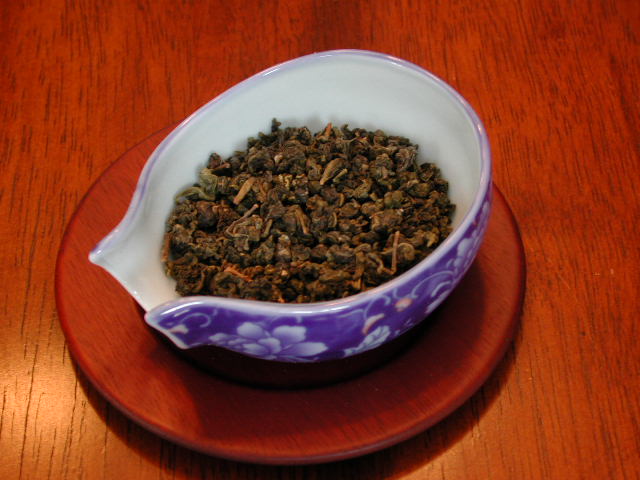
Cha he is an interesting kind of teaware for tea art. It's called "cha he" in Mandarin. They are used to display the tea to your guests before you put the tea into the teapot. It's actually a useful thing. You scoop the tea out of the tea container directly into the cha he. Then, you can use some tea tools to transfer the correct amount of tea leaf to the teapot. It's nice to allow your guests, or even yourself to get a good look; and admire the fresh tea leaves.