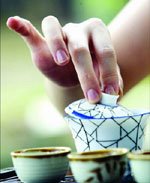
You buy a new zisha teapot, but it's not ready for use. So what can you do? You can take it home and start the long process of rearing it yourself. But if you don't have much time, that could take a very very long time before you notice any results. Or, let's say for example, you're drinking mainly sheng puer these days, but would really like this new pot to be used for Tieguanyin. But you don't have plans to drink Tieguanyin in the next few months. Is there a solution? Yes, there is. All you have to do is find a tea fanatic who will cultivate your teapot for you. And, maybe say after a few months, you can get your teapot back and start using it. Of course, it would be good if you could help your friend to cultivate one of his/her teapots with the sheng puer you're into.
In Fujian; and even all across China, this is a common practice. You buy a particular teapot from a local shop. The shop owner is friendly to you. And he/she agrees to cultivate your pot for you. So not only do you get a great pot, you get the shop owner's expertise in cultivating your teapot. And tea will be brewed in your teapot daily. And tea essence from all the great teas customers are sampling in the shop all day get poured over your teapot. So you end up with a great pot without all the work.
Of course that's in China. But if we're in North America, what can we do? Maybe we can have a buddy system and cultivate pots together with a friend. Or maybe we need to find a teapotsitter who can cultivate our teapots for us all day. Yeah. That's just what I need - a teapotsitter. My poor pots are too neglected already.
2007/12/30
Cultivating Teapots
Ferment or Oxidize?
Is tea fermented or oxidized? In fact, teas don't undergo any fermentation at all. The tea leaves are actually bruised a little, and it causes the tea leaves to undergo a chemical change when exposed to air - they get oxidized. This results in the leaves turning into a darker color. And it changes the color and taste of the tea. Then, by controlling the amount of fermentation, you can end up with totally different results from the various varietals of tea.
Take Tieguanyin, for example. Theoretically, you could produce an unfermented (or unoxidized) green Tieguanyin. Or you could oxidize it a bit, and end up with these lightly-fermented Tieguanyins that are common today. Or, you could heavily oxidize the leaves, and end up with a heavy fermented Tieguanyin. You could even go further and produce a fully fermented Tieguanyin - a red Tieguanyin.
So teas are oxidized, and not actually fermented like beer or wine. Some people ask, "Why is said to be fermented when it's actually oxidized?" It seems fermentation is a direct translation from Chinese when it comes to tea. Over a century ago, "fermented tea" became all the rage, replacing green tea as the favorite among Westerners. But all Chinese tea texts - past and present, even scientific ones always use the word faxiao (chinese character) which means fermentation. So in China everyone, tea experts, tea merchants, tea artists, tea masters all say faxiao or fermented, not yanghua (chinese characters) - oxidized. They always refer to their teas as fermented, not oxidized.
And why is that? Faxiao, or ferment is a word that we are familiar with. It's a food word, it's a good word. When we say oxidize, it sounds like a scientific word, an unfriendly word. Ferment. Oxidize. Which one sounds better? Now think of food. Say the words again. Ferment. Oxidize. Which word would you rather associate with your food?
Keep in mind, China has a very long history of wine culture; as old or even older than tea. So maybe faxiao, ferment is a word they are more intimately conscious of.
When I was in high school, I was into tea. But when I read that teas were "fermented" it worried me a little. Was I going to get drunk from my tea? Is my tea tainted with alcohol? I always made a personal choice to stay away from alcohol, because back then we heard stories of fellow students who died drinking. They got drunk, passed out, and froze in the winter cold. I didn't want to die young, and I didn't want alcohol to dumb up my brain. So I never drank. And that's why it worried me when I read that tea was "fermented". But fermented or not, I still had to drink it. Tea is just too good. But this fermentation thing still worried me enough that I had to immediately understand the process of fermentation. And after understanding it, I concluded that tea was not fermented. Instead it must undergo some other change that is not fermentation, I thought. Then I thought of tree leaves and how they could change from green to brown under certain circumstances. Tea leaves must change or ferment under similar circumstances. So then I could drink tea worry-free.
Maybe when we speak of fermentation it can confuse people, like I was. But fermentation, as opposed to oxidation is more of a people-friendly word. It's a word we associate with food. And it's a word that's most understandable to people. Just remember to make the distinction that fermented tea is not like fermented wine. There is no alcohol being produced here. Rather it's a chemical change, just as real fermentation is, that makes a dramatic change in the end product - just as grapes can change into wine.
Tea fermentation. Wine fermentation. They're two totally different subjects. But both have to do with food. I can accept the word "fermentation" when associated to tea.
So when we refer to tea do we say fermented or oxidized? I prefer the word fermented. And it's what everyone in China is saying anyway.
2007/11/25
T in China
There is tea as we know it in China. But little known is the fact there is another kind of tea in China. But this kind of "tea" is a code word, lingo among those in the know of certain girls/women who like dressing and keeping the hair short, like a tomboy. So T or "tea" in China is an alternative meaning for tomboy, or lesbian, or whatever.
In fact, there are some 36 million to 48 million homosexuals in China. And gay culture in China has a very long long history.
So, in China, you have people saying "I am tea." Which to people who understand means "I am gay."
There are a whole list of words to describe tea terms that you may not understand; although they're not much having to do with the kind of tea we drink:
T:所谓的tomboy,指比较阳刚的女同志 (Tea meaning tomboy, referring to a particularly masculine type of "female companion").
浓茶=涩tea=色t (Strong tea = astringent tea = lustful tea; or lustful whatever - you get the idea).
So what do you think? Is T your cup of tea?