2005/11/10


Gaiwan Tea Customs


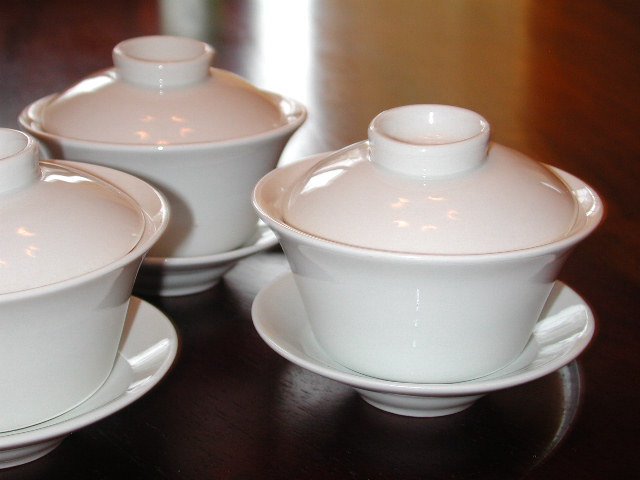
The gaiwan 盖碗 (covered bowl), also called gaibei 盖杯 (covered cup), is a popular and very simple way to both brew and drink tea.

Gaiwans are quite common in certain parts of China. In Chengdu you see them used often at teahouses.

Gaiwans are perfect for brewing a new tea that you have not tried yet. The white porcelain allows you to examine the color of the tea infusion. And you can easily examine the type of tea leaf, and the quality of tea leaf in your cup. So it's perfect for experimenting with new teas. And when you are done drinking, they are very simple to clean.


Using Gaiwan as Brewing Vessel

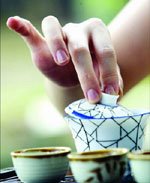
To use the gaiwan as a brewing vessel, you brew the tea. Then, you grasp the bowl and lid in one hand. Slightly tilt the lid to allow the tea to pour easily. Pour the tea directly into a serving pitcher, or into cups.

This kind of pour method is a messy business. So be sure to have tea towels on hand to wipe up the mess on your table. Better yet, use a chapan to catch all the drips.

The Gaiwan 盖碗

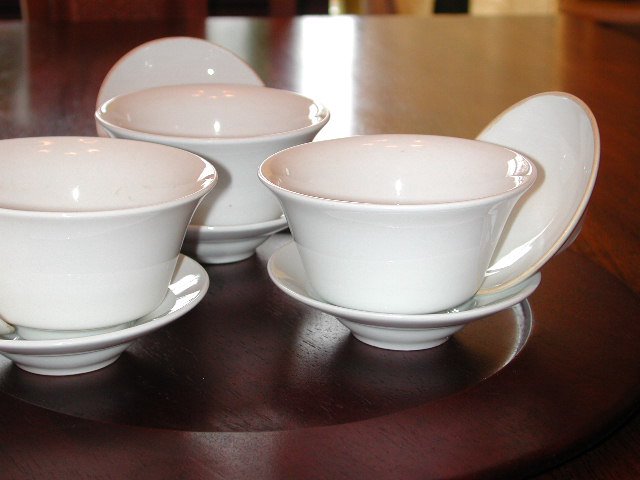
A gaiwan is a type of Chinese teaware. It is used as a drinking vessel and brewing vessel. Gaiwan literally means a "covered bowl" in Chinese. Gaiwans consist of three parts: the saucer, the bowl (or cup), and the lid.

To use a gaiwan as brewing and drinking vessel, you first heat the bowl with hot water, and spill the water out. You then place a measured amount of tea leaves in the bottom, and fill with hot water. Cover with the lid to allow the tea to steep. After a few minutes you may drink the tea directly from the cup - using one hand to grasp the saucer, and the other to hold the lid. You use the lid to strain the tea leaves to keep them in the cup, not your mouth.

2005/11/08


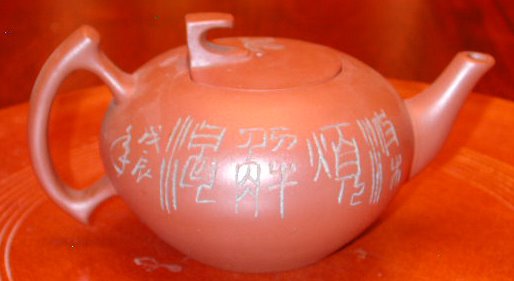
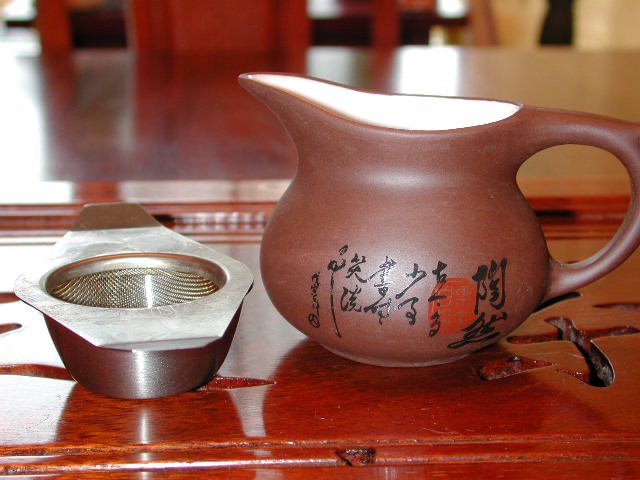
Yixing Zisha Teapot 宜兴紫砂茶壶

Here's one of my favorite teapots, and one of the first Zisha teapots I ever bought. I like the shape of this teapot. The handle and knob on the lid make it easy to handle and pour. But, so far I never used this teapot yet. I never could decide which tea I should devote to it. So it goes unused. It's kind of a waste really. But one day, I will get around to using it.

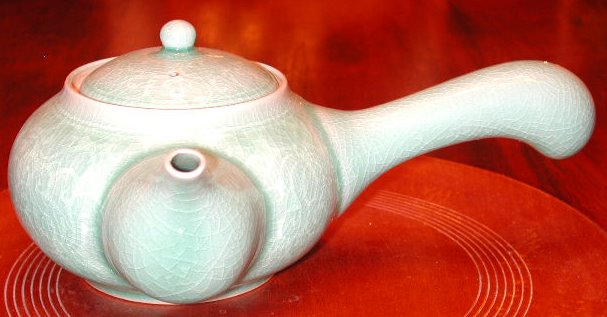
Another Korean Celadon Teapot


This is another teapot from my collection; also part of a tea set (or dagi 다기 , as it's called in Korean). Although it's not so clear in the photo, there is an interesting design underneath the glaze. Korean potters have developed celadon wares to a high level of sophistication and refinement. I like it.


Korean Celadon Teapot 韩国青瓷茶壶


Here is one of my celadon teapots; part of a tea set. Celadon comes in many styles. This one has a bamboo motif underneath the glaze. It's cool.

2005/11/07


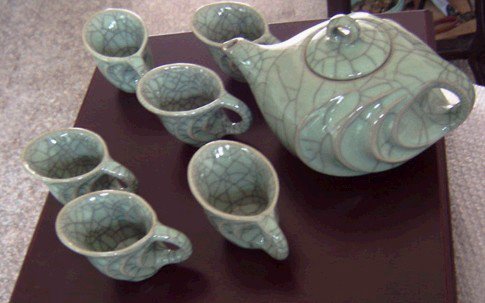
Modern Celadon Teaware 现代青瓷茶具

Here is a Chinese teaset of modern celadon. Notice the light-green colored, crackleware glaze. Some celadons have even more greener, vibrant colors, like Korean celadons.

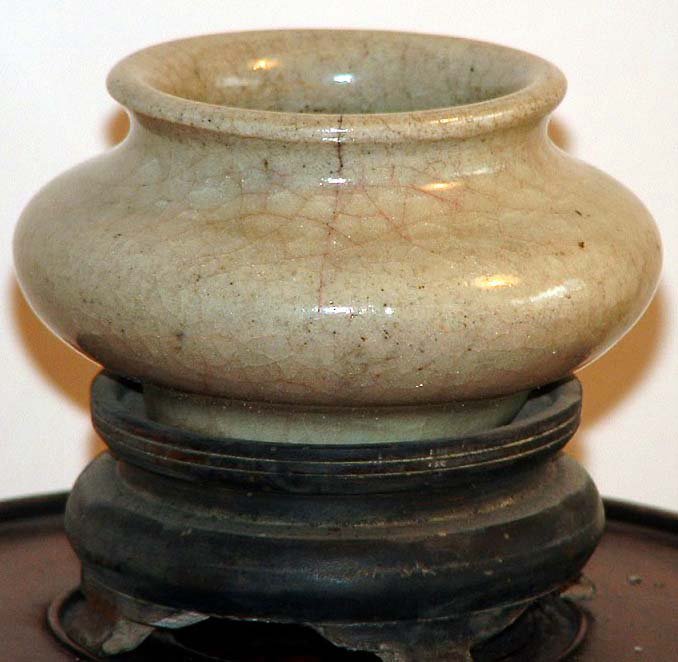
Northern Song Celadon 北宋青瓷水盂


This is a photo of a Northern Song Dynasty celadon water jar. Notice how it is not so green, but more of a yellow hue. The crackleware glaze is also apparent. Although they are called "green porcelain" in Chinese, and celadon today is defined by a green color, the earliest celadon pieces were not that green at all.

2005/11/06

Celadon

Celadon has a very fascinating history. It appeared in China in the Eastern Han period or perhaps even earlier. But definitely by the Eastern Han period (25-220 CE), Chinese were producing celadon pottery. Though, this type of celadon is certainly not the same as that of today. In the Eastern Jin dynasty (265-316 CE), we see celadon wares with typical celadon characteristics, like the crackle-ware glaze. And by the Eastern Jin period, celadon wares were already well developed. In later years, many teawares were made from celadon. Eventually, celadon spread to Korea during the Koryo Dynasty (918-1392 CE). Perhaps during the Song Dynasty (960-1279 CE), tea along with celadon teawares made their spread into Korea; and Koreans adopted the custom of producing celadon and drinking tea. With tea drinking, there comes the inevitable development of teaware and pottery techniques.

Celadon in Chinese is called "qing ci" - 青瓷. It literally means "light-green porcelain". So today, we know celadon as being a light-green porcelain. But in the past, celadon was not necessarily green in color. Some of the Jin Dynasty wares look more like a light, earthy yellow color.